
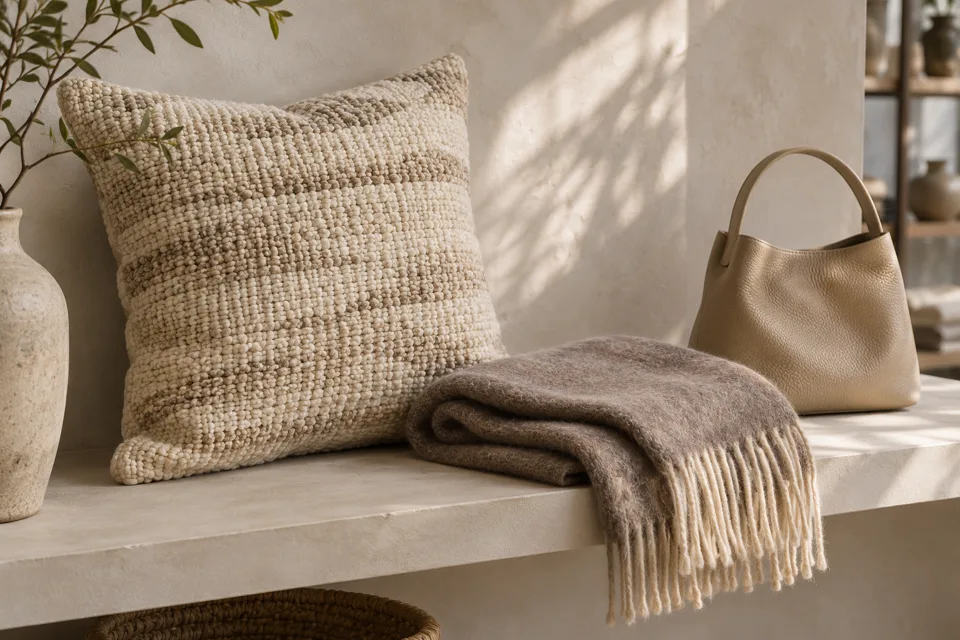
Start with the store’s customer and presentation, then give home and fashion products separate specifications. A cushion cover and a scarf can contribute to a coherent display, but their dimensions, construction, care information and intended use must be confirmed for each product. An exhibition can help find candidates; it does not verify the capabilities of each supplier.
Plan the display and the individual product
Describe the intended display, colour references and the role of each item. For a cushion cover, specify dimensions, opening and closure; for a scarf, describe dimensions, finish and intended drape. Review authorised samples side by side, while checking each against its own brief.
Screen exhibitors by their actual offer
The Maison&Objet organiser lists Decor & Design and Fashion & Accessories among its January 2027 sectors and gives the dates as 14–18 January at Paris Nord Villepinte. Use the current exhibitor directory to identify suppliers relevant to each brief; confirm whether they supply finished items, offer development or only present materials. Sector placement alone does not establish suitability.
Compare the evidence and the commercial basis
Request the actual material and care details for each proposed product. Record sample revisions, quantities, packaging requirements and quotation assumptions separately. Do not transfer a performance claim, test or care instruction from a home product to an accessory merely because their fabrics look alike.
Buying questions
Should both products use identical fabric?
Not necessarily. Select material and construction for each intended use, then check the overall presentation.
Does appearing at the fair mean a supplier can make my design?
No. Discuss and verify the specific product requirements with the exhibitor.
Sources
Related product categories
Scarves and shawlsReview your project
Share your product, market and requirements to discuss the next step.
Discuss your project →