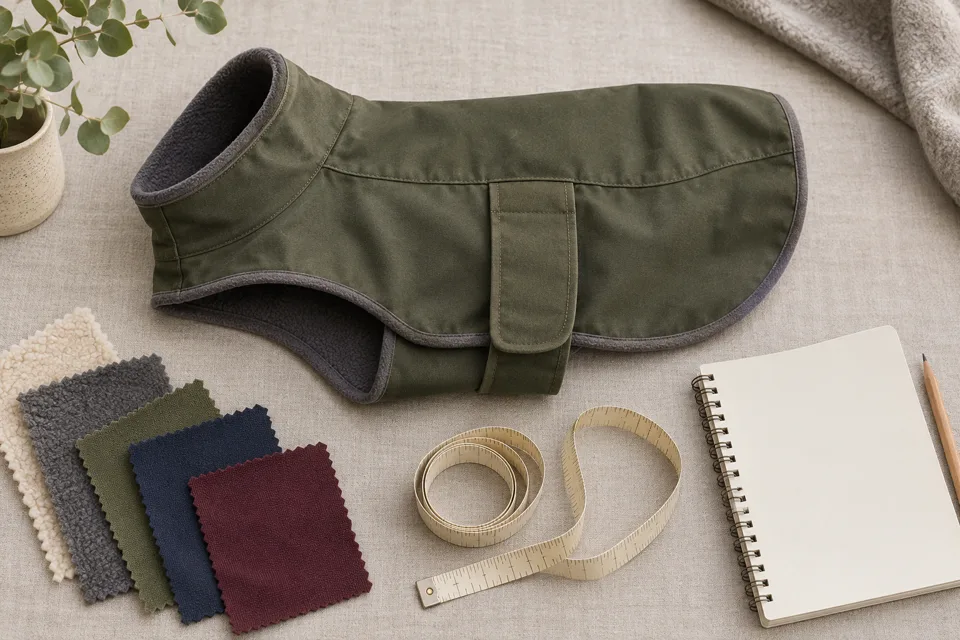
A useful brief states the animal and intended use, target market and season, body-measurement method, desired materials and construction, closure, sample review and product information. Separate confirmed requirements from details still open for development. For a dog coat, a clear brief should also specify how the team will check fit and normal movement on the sample.
Define the wearer, market and intended use
Start with the animal, intended size range, market, season and the situation in which the coat will be used. Describe the desired coverage, appearance and any existing reference you are authorised to share. A rain-use concept, an insulating layer and a fashion garment may call for different materials and construction; do not apply a performance claim to any of them until the relevant requirement and evidence are agreed.
Specify body measurements and how they are taken
State the intended body-measurement points and units, including chest circumference and back length; add neck circumference when relevant to the design. Pet Circle’s dog-coat guide discusses back, chest and neck measurements and notes that size ranges differ by brand and product. Its chart is an example, not a universal standard or a TU size chart. Keep body measurements distinct from the finished garment’s measurement points, dimensions and agreed tolerances.
Ruffwear Canada identifies chest girth at the widest part of the rib cage as the primary measurement for its jackets and refers customers to each product’s chart. Hugo & Hudson provides style-specific tables, with back, chest and neck measurements for some jackets. These are examples of different brand approaches; neither chart is a TU standard. Confirm the actual style’s measurement points and fit.
Describe the outer layer, lining and closure
Identify preferred outer and lining materials if known, the desired opening and closure, and any areas that must remain accessible. Mark features as essential or open to supplier suggestions. Ask the supplier to identify the actual proposed materials and components on the sample; a fabric’s appearance alone does not prove its composition, water resistance or durability.
Specify how the coat opens, which parts adjust and the intended position and coverage of the belly panel. Review the closure and adjustment on the actual sample and record the changes requested. Woolly Wolf describes one fleece jacket with a reinforced belly panel and an adjustable belly strap; this is one brand’s design example, not evidence of the performance or construction of a TU product.
Agree what the sample must demonstrate
Record the size, materials, colour and revision to be reviewed. Agree how measurements and fitting feedback will be documented, who can approve a change, and which additional sizes require assessment. The RSPCA advises that a dog jacket should fit without restricting movement. Where an individual animal’s comfort or health is uncertain, seek appropriate veterinary advice rather than forcing a fitting.
Add care, labels and packaging requirements
State the target care instructions or ask the supplier what can be supported for the actual materials and construction. Provide the destination market and any buyer-approved label and packaging requirements; confirm product-specific legal requirements with the responsible party. TU can evaluate pet clothing projects and coordinate development and samples through selected partners, subject to the particular product and requirements.
Next step
Share the intended animal, market and season, measurement points, reference design, closure and first-sample questions with the development team. Contact TU to discuss whether the specific project can be assessed.
Buying questions
Can a supplier use another brand’s dog-coat size chart?
A chart can be a reference, but brands and products use different ranges. Agree your own measurement method and review your sample.
Does a rain-use brief mean the sample is waterproof?
No. Define the intended claim and agree the test method, scope and evidence before making a performance claim.
What if material or care requirements are not decided?
Mark them as open questions and ask the supplier to propose options for review; do not present a proposed option as an approved specification.
Sources
- Pet Circle: Dog Coat Fitting Guide
- RSPCA: Winter and Cold Weather Care for Dogs
- Ruffwear Canada, Sizing for Jackets, accessed 19 November 2026
- Hugo & Hudson, Product Information & Sizing, accessed 19 November 2026
- Woolly Wolf: New collection Pre-order, accessed 20 November 2026
Related product categories
Hats and headwearReview your project
Share your product, market and requirements to discuss the next step.
Discuss your project →